Roof repair in New York City: fix what failed, keep what still works
We repair flat, shingle, metal and slate roofs across the five boroughs, and the masonry around them: parapets, copings and chimneys. Roof repair in New York should be the smallest piece of work that stops the water for good, which means finding the one part that failed instead of covering the whole roof with something new. Often that is a repair, not a replacement.
- Free written estimate
- Open 24 hours
- DCWP licence 2135523-DCWP
Call (929) 412-6597 Send repair photos
Water coming in right now? Go to emergency roof leak repair first; this page is about the permanent fix.
Where a roof repair stops in New York, legally
You may have read that a permit is needed once a repair passes a certain number of square feet or a percentage of the roof. That is a rule of thumb from elsewhere. New York City draws its lines differently, and they are worth knowing before anyone quotes you:
- The deck is the permit line. The Department of Buildings lists roof repair or replacement limited to the membrane, the roof covering, the cant strip and any insulation above the deck as work that needs no permit, provided the energy code does not call for more insulation. Once the deck or sheathing itself is replaced, a permit is required.
- Small repairs are outside the reflectance rule. The Building Code's reflectance requirement is waived for a job that touches less than 50% of the roof area and less than 500 sq ft. Go past either figure and the new surface has to meet it.
- Layers run out. A new covering cannot go over a wet or deteriorated roof, over slate or tile, or over a roof that already carries two or more applications. Then the job stops being a repair and becomes a tear-off.
The no-permit rule does not cancel other approvals. A building in a landmark district may still need the Landmarks Preservation Commission, and related work such as sidewalk protection or a plumbing connection is filed separately. Which of these applies is worth settling before the price, not after.
Roof repair by part of the roof
Almost every repair is at one of these places. Each card ends with what the city's code says about it, so you can check the work and not only the price.
-
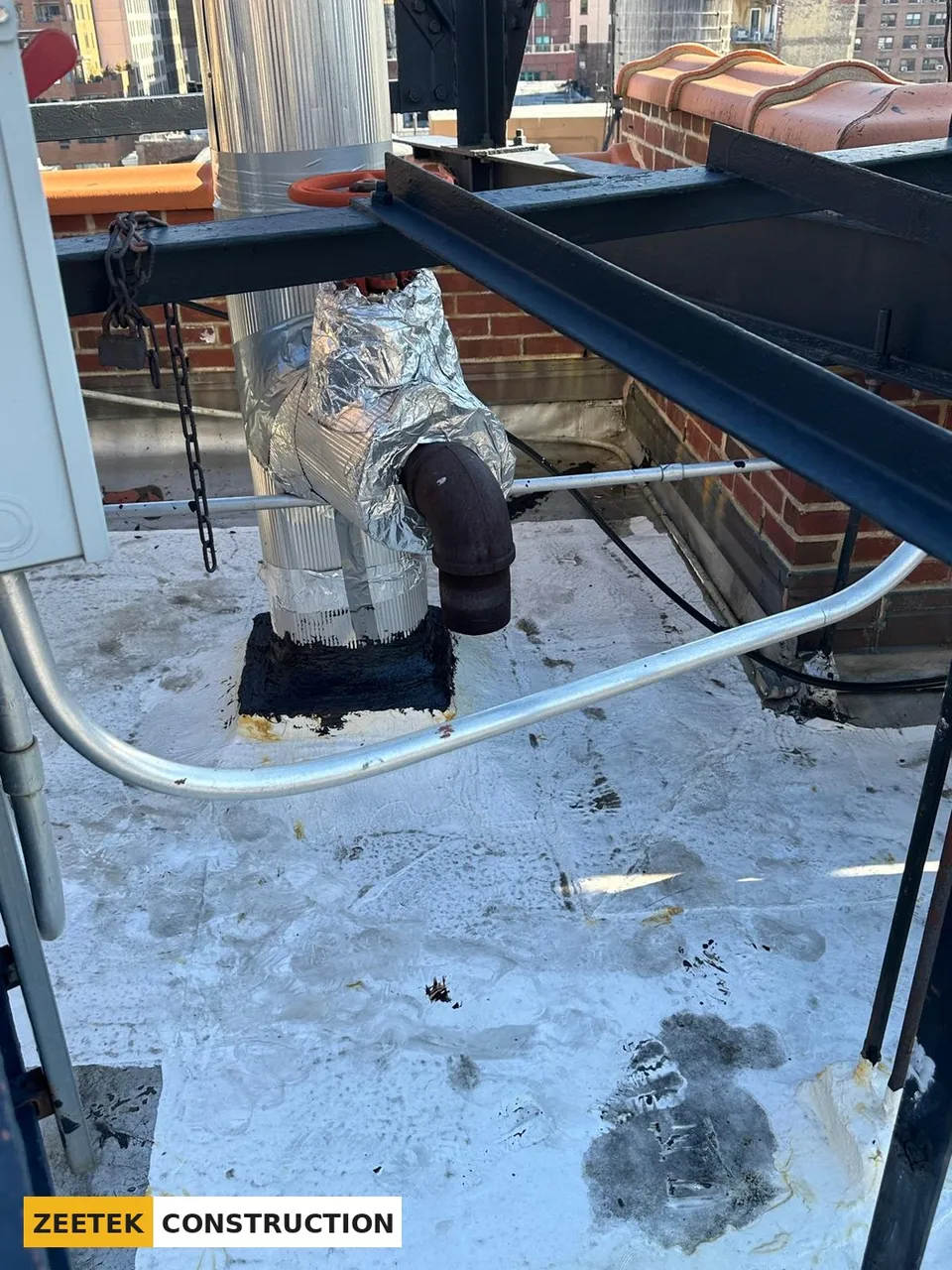
Flashing where the roof meets a wall or parapet
What goes wrong: Sealant dries out, metal rusts, the membrane pulls away from the wall.
The repair: New base and counterflashing, tucked into a cut joint rather than glued to the face of the brick.
Code: Required at every wall and roof intersection; metal at least No. 26 galvanized gauge (§1503.2).
-
Coping on top of the parapet
What goes wrong: Open joints, loose or cracked stones, water running down inside the wall.
The repair: Reset or replace the coping, repoint the joints, flash beneath it.
Code: Coping must be weatherproof, noncombustible and at least as wide as the wall (§1503.3).
-
Chimney through the roof
What goes wrong: Failed step flashing, cracked crown, water piling up on the uphill side.
The repair: Reflash all four sides; on a wide chimney, build a cricket behind it.
Code: A cricket is required behind any chimney over 30 inches wide (§1503.6).
-
Drains and scuppers on a flat roof
What goes wrong: Blocked strainer, membrane torn at the drain ring, ponding around it.
The repair: Clear, reseal or replace the drain flashing; never seal a scupper shut.
Code: Drainage follows Chapter 11 of the NYC Plumbing Code (§1503.4).
-
Membrane seams and blisters
What goes wrong: Lifted laps, splits at old patches, blisters that crack in the sun.
The repair: Cut out and patch with matching material once the roof is dry.
Code: Above-deck work only: no DOB permit (1 RCNY §101-14).
-
Shingles
What goes wrong: Lifted or missing tabs after wind, worn valleys, popped nails.
The repair: Replace the damaged courses and reseal; valleys relined.
Code: Small repairs are outside the reflectance rule (§1511.1, exception 1).
-
Slate
What goes wrong: Cracked or slipped slates, rusted nails, worn hooks.
The repair: Replace individual slates with sound ones of matching size and colour.
Code: Damaged or cracked slate may not be reinstalled (§1511.5).
We work on asphalt shingle, metal and slate roofs on houses, and on flat roofs of every common kind found on New York row houses and walk-ups. Flat roofs have a page of their own, and sloped house roofs are covered on residential roofing.
Many “roof leaks” start in the masonry
Look again at the first three rows of that table. Flashing is tucked into a brick joint, the coping sits on a brick wall, and the chimney is brick from the roof up. When the joint above the flashing opens, or the coping stones lift, water gets behind the roof membrane without the membrane being damaged at all. A roofer who patches the membrane in that situation charges you for a repair that cannot work.
Repointing, coping and chimney work are trades we do ourselves alongside roofing, so the repair goes to wherever the water actually starts. See coping and parapets and chimney repair. Open joints in the wall above a roof are a pointing job.
The order we work in
- Find the entry point, starting from where the water shows inside and working up and back along the slope or the deck, since water travels before it drips.
- Make it safe if it is still raining, with a temporary seal that is called temporary on the invoice.
- Price the permanent repair in writing. Every estimate is an itemised written scope of work, with exclusions stated.
- Repair on a dry day, because nothing bonds properly to a wet roof.
- Look again after the next heavy rain, and send us a photo if anything shows on the ceiling.
Two-year written warranty on our workmanship, from the day the job is signed off.
Already have a written quote? Send it over. We will go through it with you line by line, tell you what it covers and what it leaves out, and give you ours against the same scope.
When repair is no longer the honest answer
Leaks in new places every season, a deck that gives underfoot, wet insulation across a wide area or a roof that has already been covered over as many times as the code allows: at that point another patch is money spent on delay. What a replacement involves is on roof replacement. We would rather tell you that than sell you three repairs in a row.
Landlords with an HPD roof order
New York's housing agency issued 11,254 orders worded “repair the roof so that it will not leak” across the five boroughs in the year to October 2026. If you have one, the class and the correction date are on the notice; send it with the roof photos so we can schedule to that date. Walk-ups and buildings with a store below are covered on walk-up and mixed-use roofing.
Roof repair questions
Does a roof repair in New York City need a Department of Buildings permit?
Not if every part of the work sits on top of the deck. DOB's list of permit-free work covers the membrane and covering, the cant strip and any insulation over the deck, provided the energy code doesn't demand extra thermal insulation for that roof. Once deck boards or sheathing are replaced, a permit is needed. A landmark building may also need LPC sign-off.
Does a small patch have to meet the city's roof reflectance rule?
No, as long as it is small on both counts: under 50% of the roof area, and under 500 sq ft. A patch that passes either limit has to meet the rule.
Is a leak at the parapet a roofing repair or a masonry repair?
Often both. The flashing belongs to the roof, but it is tucked into the brick, and the coping on top of the wall is masonry. If the joint or the coping has opened, patching the roof membrane alone will not stop the water.
Get a roof repair priced
Send photos of the damage inside and of the roof if you can reach a window or the hatch safely, with the borough and cross streets. Everything else we do on roofs is on the roofing page.
Call (929) 412-6597 Ask for a repair estimate
Sources: permit line from 1 RCNY §101-14, Table 2 (IV. Roofs); flashing, coping, drainage, crickets, reflectance exception, recover limits and reinstallation from the 2022 NYC Building Code, chapter 15 (§§1503.2–1503.6, 1511.1, 1511.3, 1511.5); HPD orders from Housing Maintenance Code Violations on NYC Open Data, issued 1 November 2025 to 31 October 2026.