Walk-up building roof repair and mixed-use roofing
The six-unit walk-up. The shop with two flats above it. The three-storey building your family has owned since the eighties with a tenant on each floor. These are the buildings the outer boroughs are actually made of, and they fall between the two kinds of roofing company that advertise: too big for the one that does houses, too small to interest the one that does warehouses.
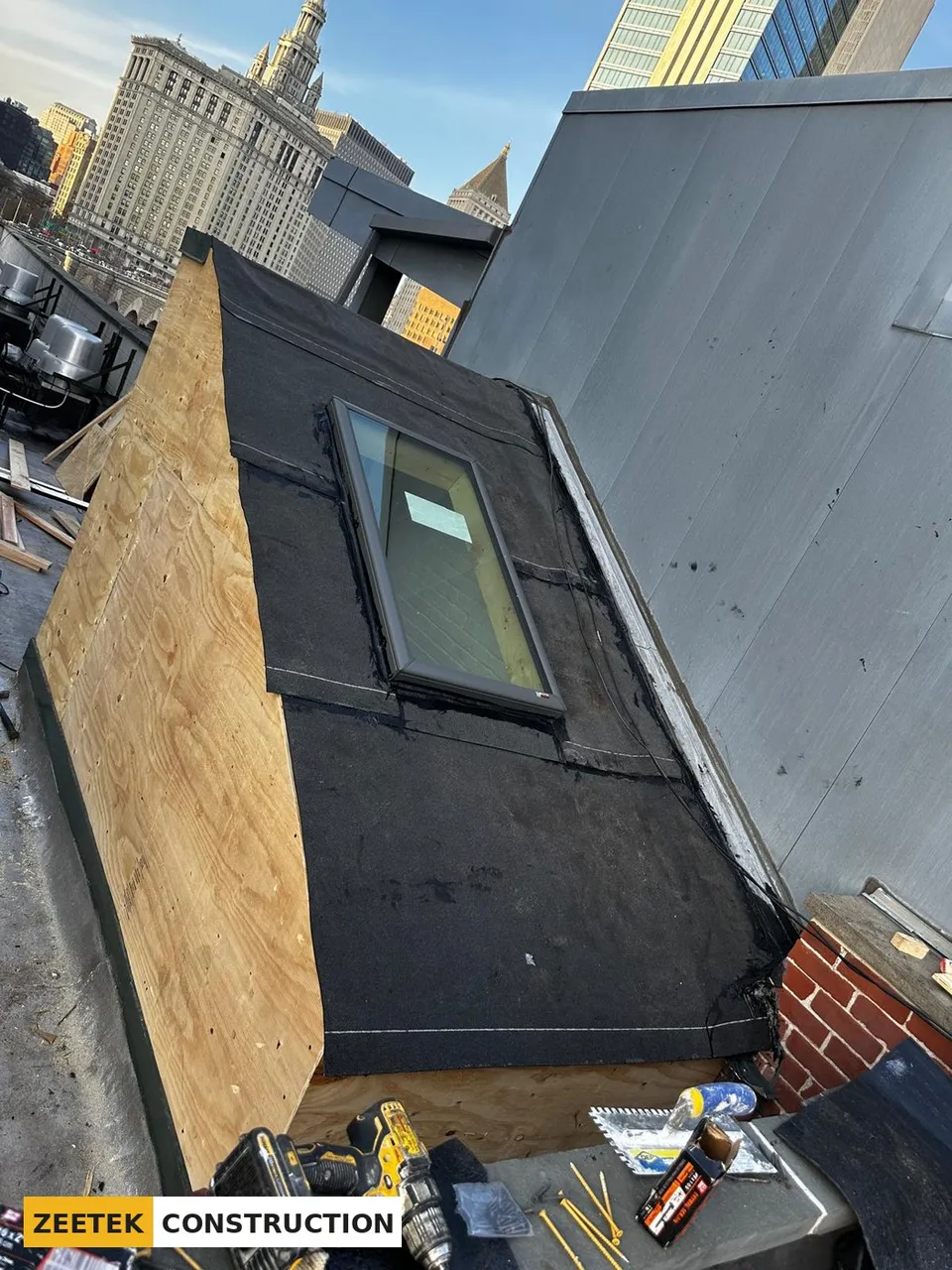
That gap is where we work. The Bronx alone has roughly 19,100 masonry walk-up apartment buildings, and they have more in common with each other than any of them has with a tower.
- NYC DCWP licensed
- Roof and parapet, one contractor
- Free written estimate
Call (929) 412-6597 Send photos of the roof
What makes a small building different from a house
Not the roof covering — that is usually the same flat, low-slope construction you would find on an attached house. What differs is everything around it:
- You have tenants, so the work has a cost beyond the invoice. A leak in a top-floor apartment is a repair bill, a rent problem and a complaint, in that order. The schedule matters as much as the price.
- There is more on the roof. Bulkhead and roof hatch, a water tank on older buildings, aerials, condenser units, vent stacks from several apartments. Every one of those is a hole through the membrane and a place it can fail.
- The parapet is taller and longer. More wall above the roof line, more coping, more joints, and a street frontage that the city has its own view about.
- Access is harder. No driveway to put a skip on, often no interior route that does not go through someone's home, and neighbours on both sides to protect.
Your roof problem is usually a parapet problem
On this kind of building more than any other, the leak reported on the top floor begins in the wall rather than the field of the roof. The parapet takes weather on both faces, it is capped by coping that moves and cracks, and the roof membrane depends on turning up into it and being held there.
A roofing contractor who does not do masonry can only replace the part of that assembly made of membrane. We repair both, which on a walk-up is usually the difference between a leak that stops and a leak that moves. Where the parapet needs rebuilding, that is facade and masonry work. The roof side is on the flat roof page.
The obligations that come with the building
Two city requirements catch small buildings that their owners often assume are only for big ones, and both are about the parapet rather than the roof.
- The annual parapet observation. Every building with a street-facing parapet needs one every year, and the rule sets no minimum height — so a three-storey walk-up is caught exactly as a tower is. What the observation covers is a guide of its own.
- The facade inspection cycle (FISP) applies to taller buildings, so most walk-ups are outside it — which is exactly why the parapet rule matters more here. If your building is in the cycle, what Unsafe and SWARMP oblige you to do is the page to read.
We repair; we do not inspect and file. The observation and the FISP report are somebody else's role, and a contractor who offers to do both has an obvious reason to find work.
Working on an occupied building
Most of what goes wrong on these jobs is not technical. It is debris coming down past a neighbour's windows, a crew needing roof access at eight in the morning through a tenant's hallway, or a top-floor apartment left open to weather overnight. So we agree the access route, the protection and the daily finish point before the work starts, and the roof is left watertight at the end of every day rather than tarped and hoped over.
If you need to give tenants notice, tell us and we will fit the schedule to it. That is easier than rearranging it afterwards.
Doing it in one mobilisation
The argument for using one contractor on a small building is not loyalty, it is the cost of setting up. Getting people, protection and a debris route onto a walk-up is a meaningful share of a small job, and paying for it twice — once for the roofer, once for the mason — is money that buys nothing.
If the roof, the parapet, the coping and the sidewalk out front all need attention within a few years of each other, doing them together is cheaper than doing them in sequence. The sidewalk is worth putting in the same conversation, since a violation runs to its own deadline.
Water tanks, bulkheads and the things nobody surveys
On a walk-up the roof is not an empty surface, and the items standing on it are where a disproportionate share of the leaks begin. They get skipped because they belong to nobody in particular: the roofer treats them as somebody else's equipment, and the owner assumes the roofer looked.
- The bulkhead and roof hatch. A door onto a roof is a wall, a threshold and a roof junction in one, and it is usually the oldest-looking thing up there.
- Condenser units and their supports. Each foot or sleeper is a point load sitting on the membrane, and units installed after the roof was laid are frequently sitting on nothing more than a patio slab and goodwill.
- Old brackets and abandoned fixings. Aerials, satellite dishes and clothes lines that stopped being used decades ago are still screwed through the roof or bolted to the parapet. If they are attached to the parapet, they are also part of what the annual parapet observation has to cover.
- Vent stacks. More apartments means more penetrations, and the lead or rubber collars on them have a shorter life than the roof around them.
When we survey a small building we photograph each of these and say which are fine, which need reflashing and which are not ours to touch. The ones that are not ours — live equipment, anything a tenant owns — we tell you about rather than quietly work around.
If your building is bigger than this
For warehouses, retail and office buildings, institutions and larger multifamily — and for TPO and PVC membranes, roof coatings and commercial maintenance contracts — that is our commercial side: commercialroofing.nyc. Same company, same licence, different kind of job.
What it costs
Written and itemised after a look. On a small building the honest variables are the condition of the parapet, how much wet material comes out, the number of penetrations to be reflashed, and access. We price the parapet work separately from the roof work so you can see which is which and decide, rather than approving one number that hides both.
Our workmanship warranty is a single sentence: Two-year written warranty on our workmanship, from the day the job is signed off.
Already have a written quote? Send it over. We will go through it with you line by line, tell you what it covers and what it leaves out, and give you ours against the same scope.
The Bronx, Queens, Brooklyn, Manhattan and Staten IslandTell us about the building
The address, how many floors and units, whether there is a shop at street level, and photographs of the roof and the parapet if you can get them safely.