Flat and low-slope roof repair
Most roofs in this city are flat, and almost nothing written about roofing is about them. Walk a street of attached houses in Norwood, Ridgewood or Bedford-Stuyvesant and nearly everything you are looking at is a flat or very low-slope roof sitting behind a parapet wall, draining through a leader inside the building rather than into a gutter at the edge. That is the roof we repair most, and it fails in ways a sloped roof does not.
- NYC DCWP licensed
- Masonry and roofing in one crew
- Free written estimate
Call (929) 412-6597 Send photos of the roof
“Flat” roofs are not flat, and that is the first thing that goes wrong
A flat roof is built with a deliberate fall so that water leaves it. When it stops leaving, everything else follows. Water standing on a roof after the rain has stopped is called ponding, and it is not cosmetic: it is heavy, it holds dirt that works into the surface, it freezes and expands in the seams, and in summer it cooks the membrane far harder than a dry roof ever gets cooked.
So when we look at a flat roof, the first question is not where the hole is. It is whether the water is still getting off the roof at all, and if not, why: a blocked or undersized drain, a deck that has sagged between joists, insulation that has gone soft and compressed, or a previous repair that built up a dam across the fall.
Where it actually leaks
Almost never in the open middle, which is the part everyone looks at first. A flat roof leaks at its edges and at its interruptions.
- The parapet base. Where the roof surface turns up the wall is the single most common entry point on an attached building. The turn-up is the part that moves most, gets the least attention and is the hardest to do properly.
- The coping on top of the parapet. Water that gets under a cracked or displaced coping stone runs down inside the wall and comes out below the roof line, which is why it is so often misread as a roof leak. Every street-facing parapet in the city also needs an annual observation under Local Law 126, at any height, so this is worth looking at whether or not you have a leak.
- Around the drain, where the membrane is cut, clamped and relied upon to stay sealed for decades.
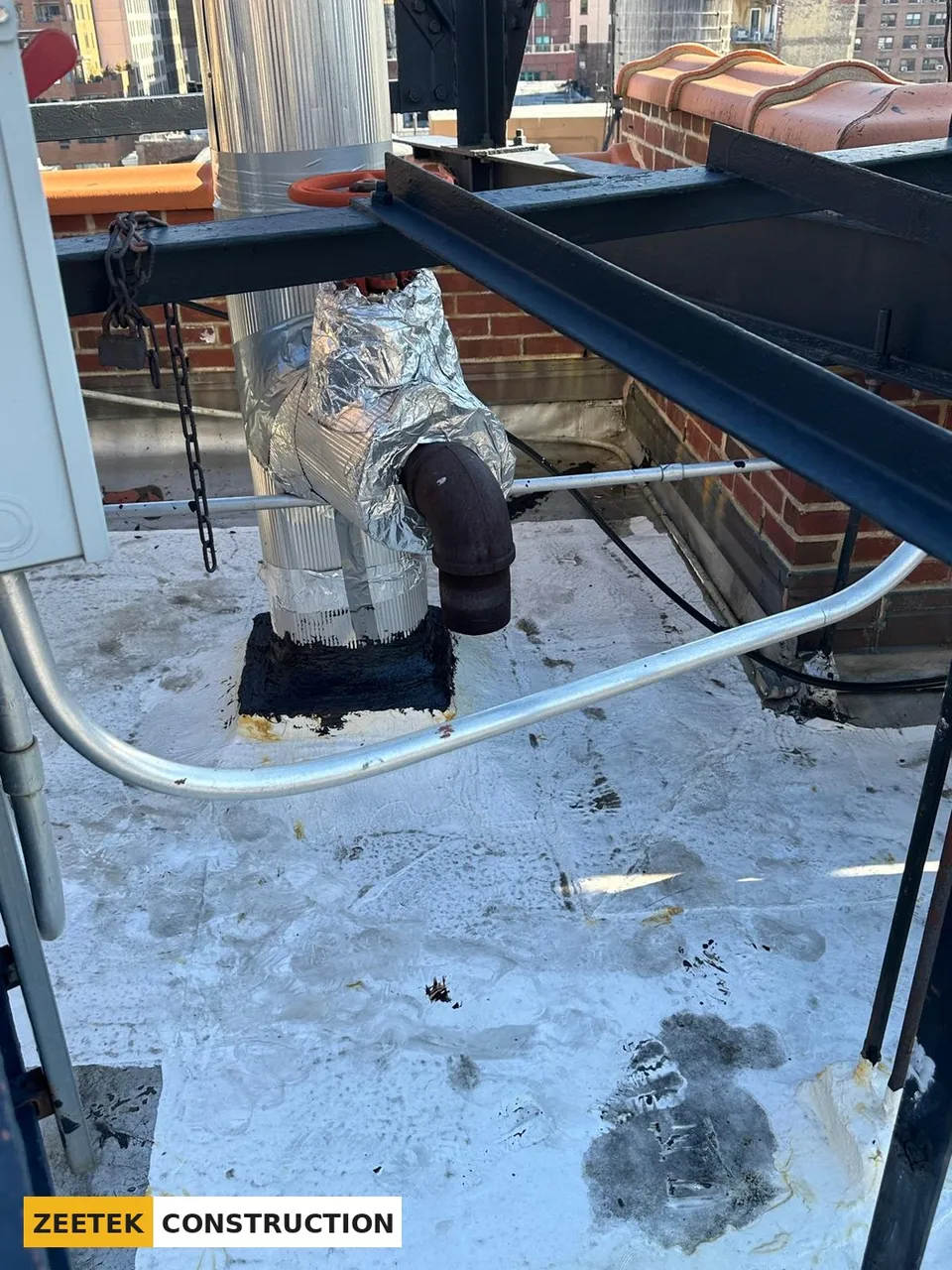
- Anything passing through: vents, soil pipes, the bulkhead, a skylight curb, an old aerial bracket nobody has used since the 1990s.
- Seams, blisters and previous patches. A blister is trapped moisture or air; it is not itself a leak, but it is a weak point that will become one.
The surfaces you will find on a New York flat roof
Knowing what is up there changes the repair, and on a building that has been around a while there are often two or three layers of history:
- Built-up roofing — layers of felt in bitumen, often with gravel. The oldest thing you will still find in service.
- Modified bitumen — rolled sheets, torched or adhered, usually with a mineral-surfaced cap sheet. The most common replacement on houses and walk-ups.
- Single-ply membranes — rubber or plastic sheets, repaired by welding or by a compatible patch rather than by anything hot.
- Silver or aluminium coating over any of the above. Worth saying plainly: a coating is maintenance, not a repair. Painting over a split seam hides it for one season.
Putting the wrong patch on the wrong surface is one of the most common reasons a repair fails: torching onto a single-ply membrane damages it, and a bitumen patch will not bond to a plastic one. Part of the reason we look before quoting is to know which it is.
Nothing permanent bonds to a wet roof
In rain, snow or on a roof that has not dried, the honest job is a temporary repair that stops water getting in and buys the building time. That is not a lesser version of the work; it is the only thing that holds, because every permanent repair needs a dry, clean surface to bond to. Sealing over trapped water gives you a blister and a failure within a season. If water is coming in right now, start here.
What is under the membrane matters more than the membrane
When a flat roof has leaked for a while, the water does not sit in the hole. It spreads sideways into the insulation and into the deck. A repair that seals the top and leaves wet insulation underneath traps that water against the deck, and the deck is wood.
So on anything beyond a small, fresh leak, the repair means cutting the wet material out back to dry, sound material, checking the boards underneath, replacing what has gone soft, and then rebuilding the layers. That is also the part nobody can price from the street, which is why our estimate states what we have assumed about the deck and what it costs if the assumption is wrong.
Repair, recover, or replace
Three different jobs, and contractors are not always straight about which one you need.
- Repair — the failure is local, the rest of the surface has life in it, and the deck is sound. The right answer far more often than the quoting habits of this trade suggest.
- Recover — a new layer over the existing one. Cheaper and quicker, but it buries whatever is wrong underneath, including wet insulation, and there is a limit to how many layers a roof may carry.
- Replace — everything comes off down to the deck. The only honest answer when the deck is going or the surface has failed generally rather than in one place.
One thing worth knowing before you choose: a replacement brings the current code into the conversation in a way a repair does not. Section 1504.9 of the NYC Building Code sets a reflectance standard for roof coverings, and for a roof at or below a slope of two in 12 — which is every roof on this page — the bar is the high one: 0.70 initial solar reflectance with 0.75 thermal emittance, or a Solar Reflectance Index of 82. That is the white-roof rule, and it is a reason a replacement is specified differently from a patch. Replacement is its own page.
Why a masonry contractor repairs your flat roof
Because on an attached building the roof and the parapet are one piece of construction. The membrane turns up a masonry wall, tucks into a masonry joint and finishes under a masonry coping, and a very large share of what gets diagnosed as a roof leak is actually happening in one of those three.
A roofer who does not do masonry has to stop at that line and tell you to call someone else; a mason who does not do roofing has the same problem from the other side. We repair both on the same visit, which is the whole reason this company does the two trades together. Where the parapet needs rebuilding rather than repointing, that is facade work. Where the water is coming through the wall below the roof line entirely, it is a wall problem.
What it costs, and what moves the number
We give a written, itemised price after looking, not a figure on the phone. What moves it: the size of the failed area, how much wet insulation and soft decking comes out, whether the parapet and its coping need work at the same time, access to the roof, and how many existing layers are up there. Of those, the deck is the one that genuinely cannot be known in advance, so the estimate states the assumption and the cost of being wrong rather than leaving it to be discovered.
Our warranty on the work is a plain sentence rather than the word guaranteed: Two-year written warranty on our workmanship, from the day the job is signed off.
Already have a written quote? Send it over. We will go through it with you line by line, tell you what it covers and what it leaves out, and give you ours against the same scope.
The Bronx, Queens, Brooklyn, Manhattan and Staten IslandSend photographs
A photograph of the roof from a window or a neighbouring building, one of the parapet and one of the stain inside will usually tell us more than a description. Add the borough and the cross street.