Paver installation for patios, walkways and driveways
Pavers are the one outdoor surface where the part you pay for and the part that decides the result are completely different things. You choose the stone. What determines whether it is still flat in five years is the six to twelve inches underneath it that nobody ever sees.
- NYC DCWP licensed
- Concrete and masonry in the same crew
- Free written estimate
Call (929) 412-6597 Send photos of the area
Why pavers sink, and why it is never the pavers
A paved surface is not held up by the stones. It is held up by a compacted stone base built on a prepared subgrade, with the pavers bedded on a thin layer above it and locked together at the edges. Take any part of that away and the surface moves.
So when we are called to a patio that has gone wavy, dipped in one corner or thrown up a trip edge, the pavers themselves are almost always fine. What has happened is one of three things: the base was too shallow or was never properly compacted, water got underneath and washed the bedding out, or there was no edge restraint and the whole field slowly spread sideways.
That is also why a paved area can be lifted, re-based and relaid using most of the original stone. If your patio has sunk, you may not need new pavers at all — you need the thing under them rebuilt.
How we build one
- Excavate to a depth set by what the surface will carry. A patio and a driveway are not the same dig, and a driveway that was built like a patio is a driveway that will rut.
- Prepare and compact the subgrade, so the base is sitting on something that will not move.
- Lay and compact the stone base in layers rather than all at once, because a thick layer compacted in one pass is compacted only at the top.
- Set the falls. Water has to leave, and it has to leave away from the building. This is the step that gets skipped on a flat-looking yard, and the consequence shows up in a basement.
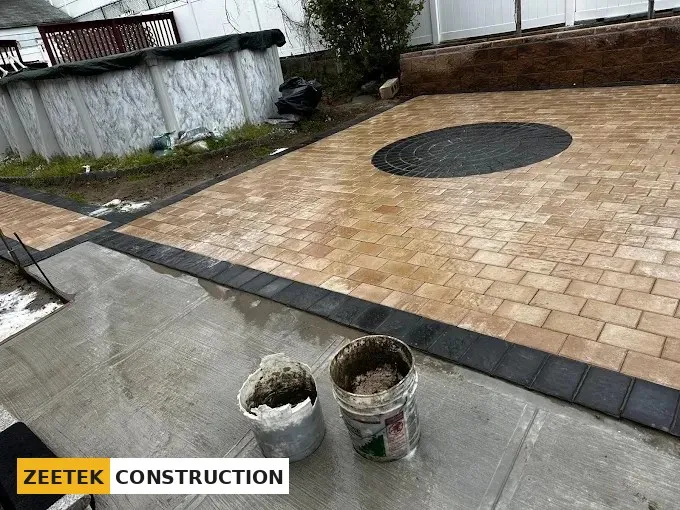
- Screed the bedding layer, lay the pavers to the pattern, and cut the edges properly rather than filling gaps with mortar.
- Edge restraint, then joint and compact, so the field is locked and the joints are filled.
Where the water goes is the part to argue about
A new patio or driveway changes how water moves across your property, and in a city of attached and semi-detached houses the available fall is often small. Getting it wrong puts water against the house, which is the beginning of a basement problem rather than a paving one.
We will tell you where the water is going before we build, and if the answer is unsatisfactory we will say what needs to change — a drain, a different level, taking a downspout somewhere else. Since below-grade waterproofing is our own trade, we see the far end of that mistake often enough to care about it.
Pavers or poured concrete?
We do both, so here is the honest comparison rather than a sales one.
- Pavers flex slightly with ground movement instead of cracking, individual units can be lifted and replaced, and a settled area can be taken up and re-laid. They cost more up front and the joints need occasional attention.
- Poured concrete is usually cheaper, gives an unbroken surface, and is the right answer for a sidewalk. When it cracks or settles it cracks as a slab, and the repair is a replacement. That is concrete work.
For a city sidewalk the question does not arise: the pavement in front of your building is repaired to the city specification, in concrete. Sidewalk work is its own page, and it has its own deadlines if you have a violation.
Steps, borders and the things that finish it
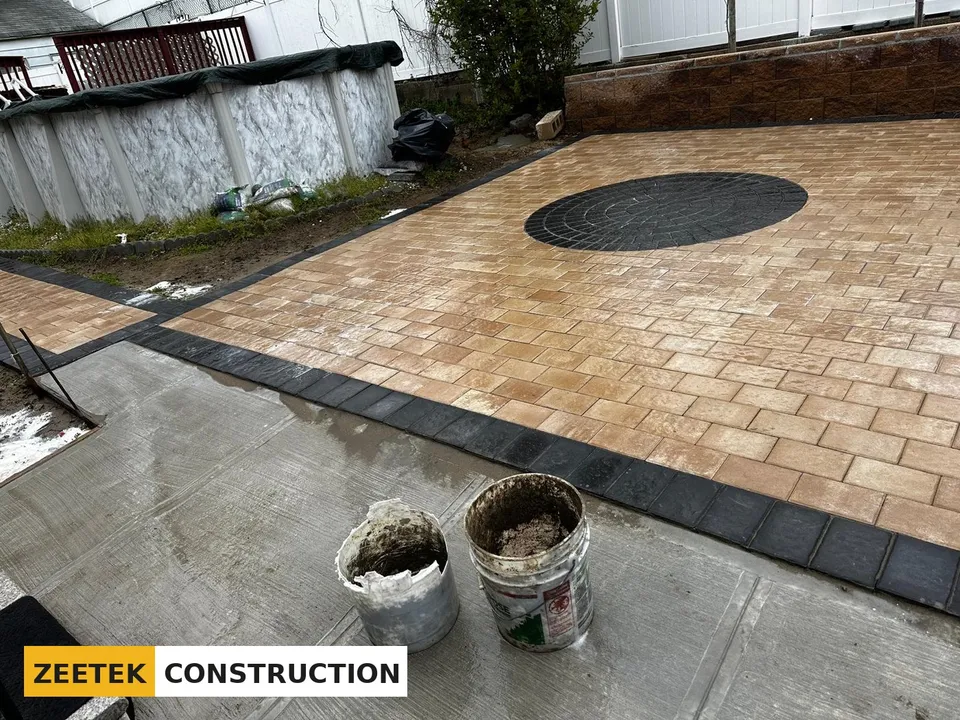
Most paving jobs are not just a flat field. There are steps up to a door or down to a yard, a border course in a contrasting stone, an inlay, a retaining edge where the ground changes level, or a path that has to meet an existing stoop without a lip in it.
Those junctions are masonry, which is the trade we came from, and they are where a paving job either looks built or looks laid. Where the steps themselves need rebuilding, that is stoop and step work. Where the change in level is big enough that the ground has to be held back rather than edged, it is a retaining wall, and the drainage behind it matters more than the face of it. And where a paved area ends at a boundary, the fence or gate along it is usually better set while the ground is already open.
Living with them: the honest maintenance picture
Pavers are low maintenance, not no maintenance, and the two things that actually need doing are small.
- Joints lose sand. Rain, sweeping and a pressure washer held too close all take jointing material out, and empty joints are where weeds start and where movement begins. Topping them up occasionally is a ten-minute job and it is the single thing that keeps a paved area tight.
- Winter is harder on them than summer. De-icing salt is rough on some stones and on the jointing, and a metal shovel chips edges. Sand, or a de-icer suited to the stone, and a plastic blade, will add years to how it looks.
Sealing is optional and is a matter of taste rather than necessity. It deepens the colour, makes some staining easier to clean, and has to be redone periodically. We will tell you what a given stone actually needs rather than selling it as part of the job by default.
Efflorescence — a white haze that can appear on new pavers in the first year — is worth knowing about in advance, because it looks like a fault and is not one. It is salts coming out of the material as it dries, it is normal on new work, and it usually weathers off on its own.
What it costs
Every estimate is an itemised written scope of work, with exclusions stated. The number moves on the area, the depth of excavation the use requires, how much spoil has to be carted away, access to the back of the property, the stone you choose, and how many cuts, steps and borders there are. Access is a real factor in this city: a back yard reached only through the house is a different job from one with a driveway beside it.
Our workmanship warranty: Two-year written warranty on our workmanship, from the day the job is signed off.
Already have a written quote? Send it over. We will go through it with you line by line, tell you what it covers and what it leaves out, and give you ours against the same scope.
The Bronx, Queens, Brooklyn, Manhattan and Staten IslandSend photographs of the area
The space as it is now, from a couple of angles, plus anything it has to meet — a back door, a step, a wall, a drain. Rough measurements help, and so does telling us whether anything is parked on it.