Retaining wall contractor: construction and repair
A retaining wall is not holding up soil. It is holding back water that happens to have soil in it. Nearly every failed wall in this city failed because the water behind it had nowhere to go, and the wall ended up carrying a load it was never built to carry. That is why the part of the job you can see — the blocks, the stone, the cap — is the part that matters least.
- NYC DCWP licensed
- Masonry, concrete and drainage in one crew
- Free written estimate
Call (929) 412-6597 Send photos of the wall
Why walls lean, bulge and come apart
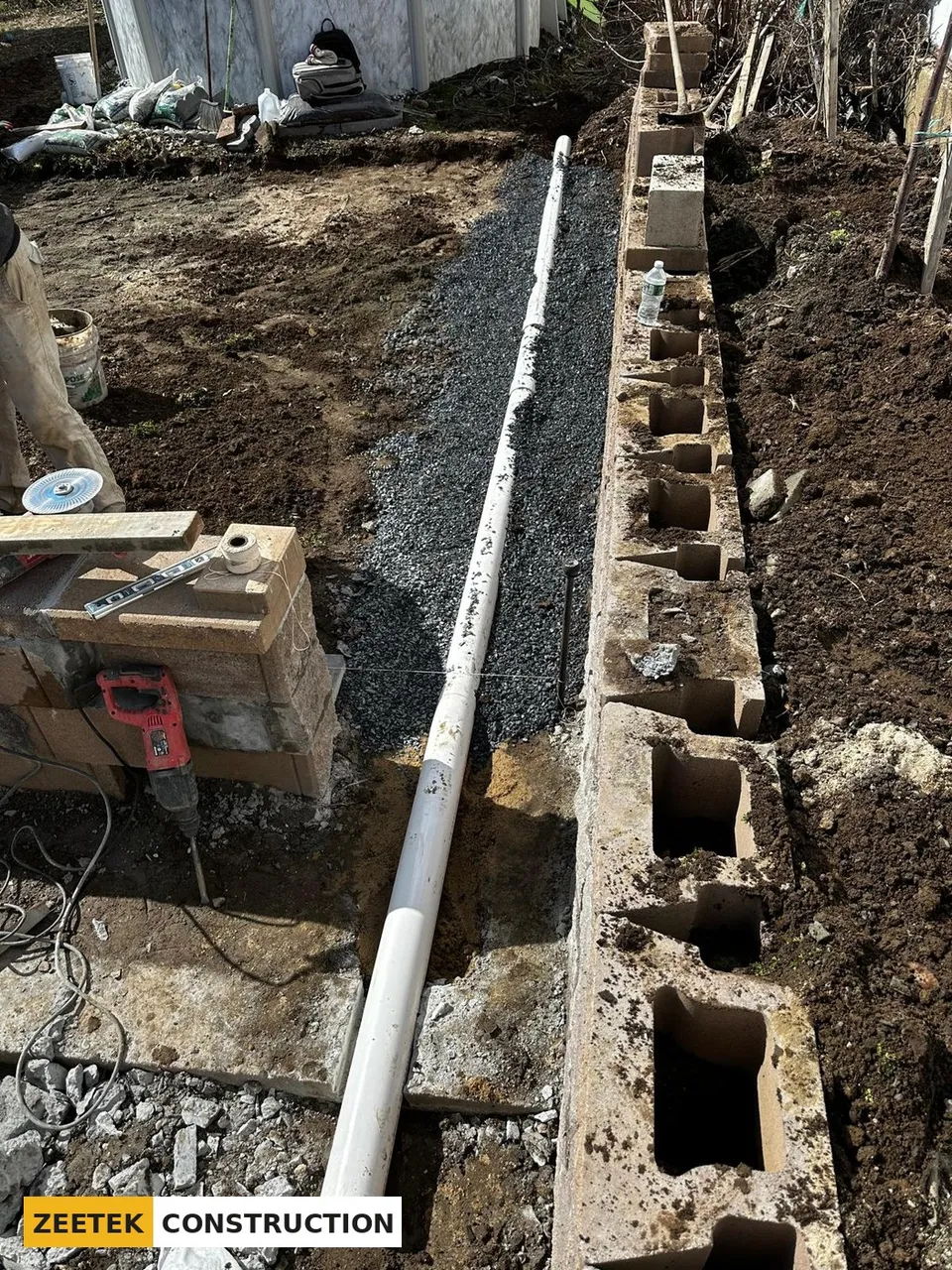
Soil that is holding water weighs far more than dry soil and pushes far harder. A wall built with free-draining stone behind it and a perforated pipe at the bottom lets that water leave before it can push. A wall backfilled with the clay that came out of the hole does not: the ground behind it saturates, the pressure rises, and the wall starts to tell you about it.
The symptoms arrive in a fairly reliable order. First the wall tilts forward slightly at the top, or a course opens up at one end. Then the joints step out of line, the cap moves, and water starts appearing at the face in wet weather instead of at the weep holes. By the time a wall is visibly bulging in the middle, the question is no longer how to repair the face.
Freeze and thaw finishes the job. Water held in saturated ground behind a wall expands every time it freezes, and New York gives it plenty of opportunities. This is why a wall that stood for twenty years can go in two bad winters once its drainage silts up.
The ten-foot rule, and whether your wall is caught by it
Most people are surprised to learn that New York inspects retaining walls on a cycle at all. It does. 1 RCNY §103-09 requires “a critical examination of any retaining wall: (i) with a height of ten feet or more at any point along the length of such wall; and (ii) which fronts on a public right-of-way” to “be conducted by a QRWI once every five (5) years.”
Three definitions in the rule decide whether that catches you, and two of them trip people up.
- How the height is measured. It is “the vertical distance, measured from the ground surface above the toe of the wall to the top of the wall, wall stem, or wall step for tiered walls, including any parapets or fencing intended for retaining material.” A fence on top that is holding material back counts toward the ten feet. So can a tiered wall measured the wrong way. Fencing that is only marking a boundary rather than holding material back is an ordinary fence, with its own and much lower height limits.
- What counts as a public right-of-way. Broadly, almost anything public: “a public highway, railroad, street, avenue, alley, public driveway, sidewalk, roadway or any other public place or public way.” A wall along the sidewalk is fronting a public right-of-way.
- What is not a retaining wall. The rule means “a wall that resists lateral or other forces caused by soil, rock, water or other materials”, and expressly excludes “basement walls and vault walls that are part of a building, and underground structures”. A foundation wall holding back earth is a different conversation, and if that is what you have, the basement waterproofing page is the right one.
If both limbs are met, the examination is not optional and it is not something a contractor can do for you. It must be carried out “by or under the direct supervision of a QRWI” — a Qualified Retaining Wall Inspector — retained by the owner, and the rule is blunt about what that involves: the final inspection “must, at a minimum, include an in-person visual examination of the entire length from both sides of the retaining wall. A drive-by inspection is not acceptable.”
The filing window is set by borough
Reports are filed in one-year windows that rotate through the boroughs, then repeat every fifth year. The first cycle runs:
- The Bronx — 1 January to 31 December 2024, and every fifth year after that.
- Manhattan — 1 January to 31 December 2025, and every fifth year after that.
- Staten Island — 1 January to 31 December 2026, and every fifth year after that.
- Queens — 1 January to 31 December 2027, and every fifth year after that.
- Brooklyn — 1 January to 31 December 2028, and every fifth year after that.
The penalties are set out in the same rule and they are not nominal. Failing to file an acceptable initial report is “a civil penalty of five thousand dollars ($5,000) per year”. Filing late adds “one thousand dollars ($1,000) per month” on top. Failing to correct an unsafe condition is another “one thousand dollars ($1,000) per month, pro-rated daily, until the unsafe condition is corrected”.
What the four ratings oblige you to do
A report gives the wall one of four ratings, and each one starts a different clock. A safe wall is “fully functional with no action required”. Safe with minor repairs means minor repair or routine maintenance within the next five years. Safe with repairs and/or engineering monitoring means repair within five years “but not less than one year”, with monitoring alongside. An unsafe finding is the one with teeth: the owner “must immediately commence such repairs or reinforcements”, and “all unsafe conditions must be corrected within 90 days from the submission of the critical examination report.”
Those middle two ratings are where we are usually called, and they are the cheap end of this problem. A wall rated for minor repairs that is dealt with in year one is ordinary masonry work. The same wall left until it is rated unsafe is a 90-day deadline with a monthly penalty running behind it.
What the city itself calls repair
The rule defines the word, and the definition is worth reading because it is not vague. Repair is “the non-routine fixing and restoring of wall elements to their intended function, including, but not limited to, resetting dislodged stonework, repointing stone masonry, re-grading or reseeding adjacent slopes, patching concrete spalls, mending damaged wire baskets, and repair or replacement of the drainage system.”
Maintenance is defined separately as “vegetation removal, weep holes, cleaning wall drains, removing debris from culverts, replacing dislodged chinking, painting soldier piles, cleaning and sealing concrete and wood facings.”
Read those two lists and the city has described a masonry and drainage trade. Resetting stonework, repointing, patching spalls and putting the drainage back are the everyday work of this company, which is why retaining walls sit naturally beside masonry and concrete rather than being a separate speciality.
Where we stop and an engineer starts
A wall of ten feet or more fronting a public way is on a professional’s inspection cycle, and that professional is not a mason. We do not perform critical examinations, we do not file reports, and we are not the people who design an engineered wall or certify one.
The same line applies below ten feet when a wall is behaving badly. If it is leaning, bulging, or cracking through the units rather than through the joints, something structural is going on and rebuilding the face will hide it rather than fix it. That is an engineer’s question first. We will say so rather than take the work, which is the same position we take on a bulging building wall.
Where the rule requires an owner to cordon off a dangerous area or erect protection, that duty sits with the owner and with the professionals who provide it. We do not put up sidewalk sheds or safety netting.
What we build, and how
- Garden and landscape walls in block, natural stone or poured concrete, with the base, the drainage and the backfill done properly rather than quickly. These are the everyday job and they are ordinary construction.
- Rebuilds of failed walls, which usually means taking the wall down, finding out what the ground is actually doing, and putting the drainage in that was never there.
- Repairs in the sense the rule means it — resetting displaced stone, repointing, patching spalled concrete, clearing or replacing a blocked drainage system and reopening weep holes.
- The wall and what sits on it together. A retaining wall at the front of a property usually arrives with steps, a path or a driveway attached to it, and those move with the wall. We would rather price them as one job than repair a wall and leave the paving to settle again.
What it costs
Every estimate is an itemised written scope of work, with exclusions stated. On a retaining wall the number moves on height and length, what the wall is built from, how much excavation and how much spoil has to leave the site, whether there is access for a machine or whether it is all by hand, and what has to be done about the drainage. Access decides more than people expect: a back garden reached only through the house is a different job from one with a driveway beside it.
Our workmanship warranty: Two-year written warranty on our workmanship, from the day the job is signed off.
Already have a written quote? Send it over. We will go through it with you line by line, tell you what it covers and what it leaves out, and give you ours against the same scope.
The Bronx, Queens, Brooklyn, Manhattan and Staten IslandSend photographs, including the ground behind
The wall end to end, straight on and from each end so any lean shows, plus the ground above and behind it and anything sitting on top. If you have had a report on the wall, send that too — the rating and the date tell us which clock you are on. The estimate page will build the message for you.