Limestone and granite stone restoration
Stone is the material people assume needs the least looking after and it is the one where a bad decision is hardest to undo. A brick can be cut out and replaced. A mortar joint can be raked and refilled. But the worked face of a limestone sill or a granite tread is the stone itself, and once it has been taken off there is nothing to put back.
- NYC DCWP licensed
- Limestone, granite and brownstone
- Free written estimate
Call (929) 412-6597 Send photos of the stone
The rule that decides everything else
There is a single sentence from the Secretary of the Interior’s Standards that the whole trade turns on, and it is quoted at the top of the National Park Service’s own guidance: “The surface cleaning of structures shall be undertaken with the gentlest means possible.”
It sounds like a preference. It is closer to a law of physics. Nearly every ruined stone front in this city was ruined by somebody being in a hurry with something harder than the stone.
Why sandblasting ruins stone, in the NPS’s own words
Preservation Brief 6 puts it bluntly: “The crux of the problem is that abrasive cleaning is just that — abrasive.” Abrasive methods “‘clean’ by eroding dirt or paint, but at the same time they erode the surface of the historic building material.”
For stone, the damage is specific and permanent. “Some types of stone develop a protective patina or ‘quarry crust’ parallel to the worked surface (created by the movement of moisture towards the outer edge), which also may be damaged by abrasive cleaning.” That crust is the stone’s own weathering skin, formed over decades. Blast it off and the soft interior is exposed to the weather for the first time since it left the quarry. Even tooled granite — about as hard as this trade gets — is left, in the Brief’s words, “more susceptible to accelerated weathering”.
The same applies to the brick around the stone: abrasive methods “remove the hard, outer protective surface, and therefore make the brick more susceptible to rapid weathering and deterioration”, and “grit blasting may also increase the water permeability of a brick wall”, because “the impact of the grit particles tends to erode the bond between the mortar and the brick, leaving cracks or enlarging existing cracks where water can enter”.
And it does not even achieve the thing it was done for. “Erosion and pitting of the building material by abrasive cleaning creates a greater surface area on which dirt and pollutants collect. In this sense, the building fabric ‘attracts’ more dirt, and will require more frequent cleaning in the future.” A blasted front gets dirty faster than the one next door that was left alone.
What we actually do to a stone front
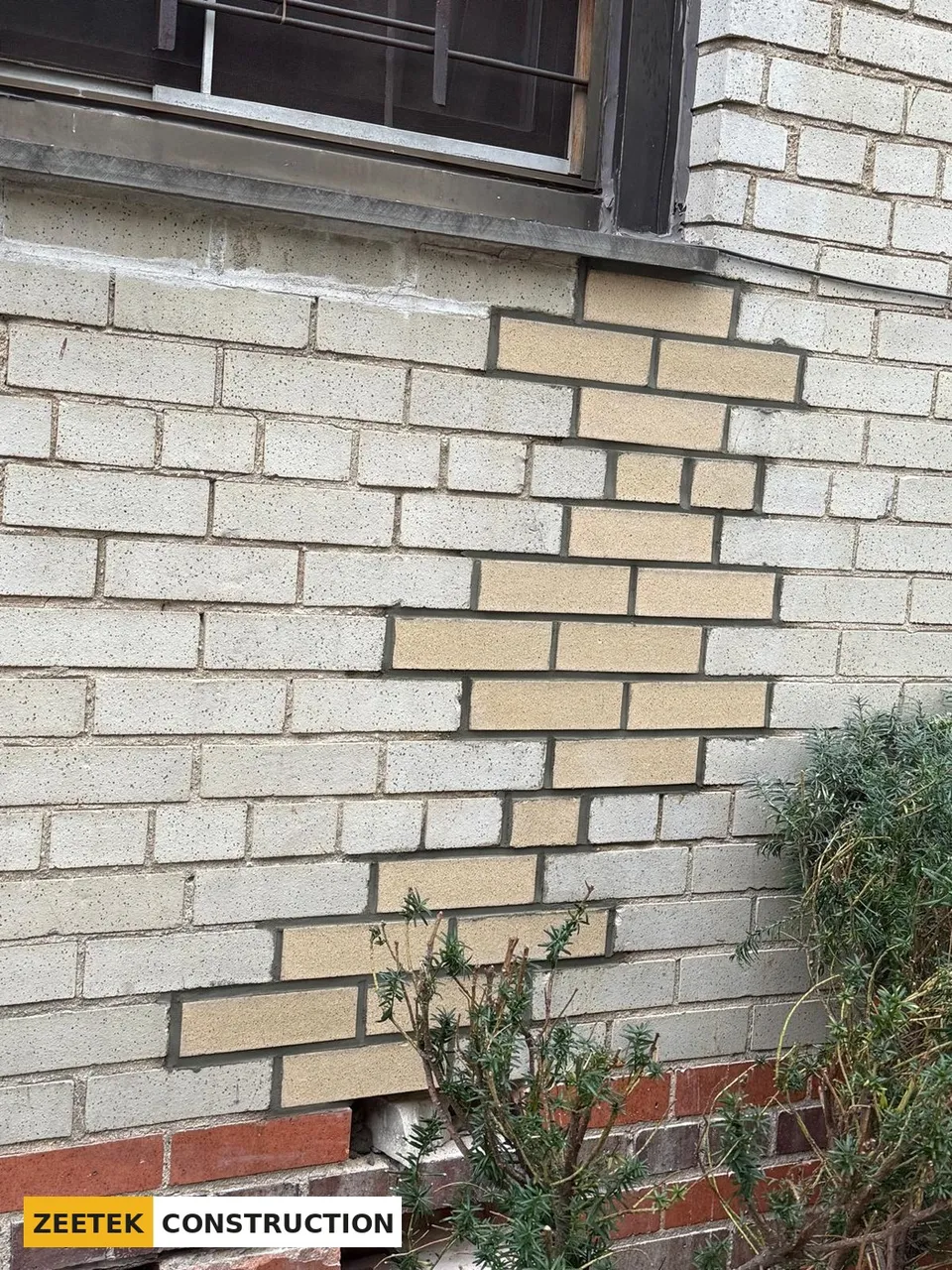
- Cut out and replace what has failed. Individual stones that have spalled, delaminated or cracked through are cut out and new units set in, matched for size, colour and finish as closely as the material allows. This is the same discipline as replacing brick in a wall: the new unit has to key into the existing coursing, not sit on top of it.
- Repoint the joints. Stone joints fail the same way brick joints do and for the same reason, and the mortar has to be softer than the stone around it. That argument is set out in full in the repointing guide, and it matters more on soft stone than anywhere else.
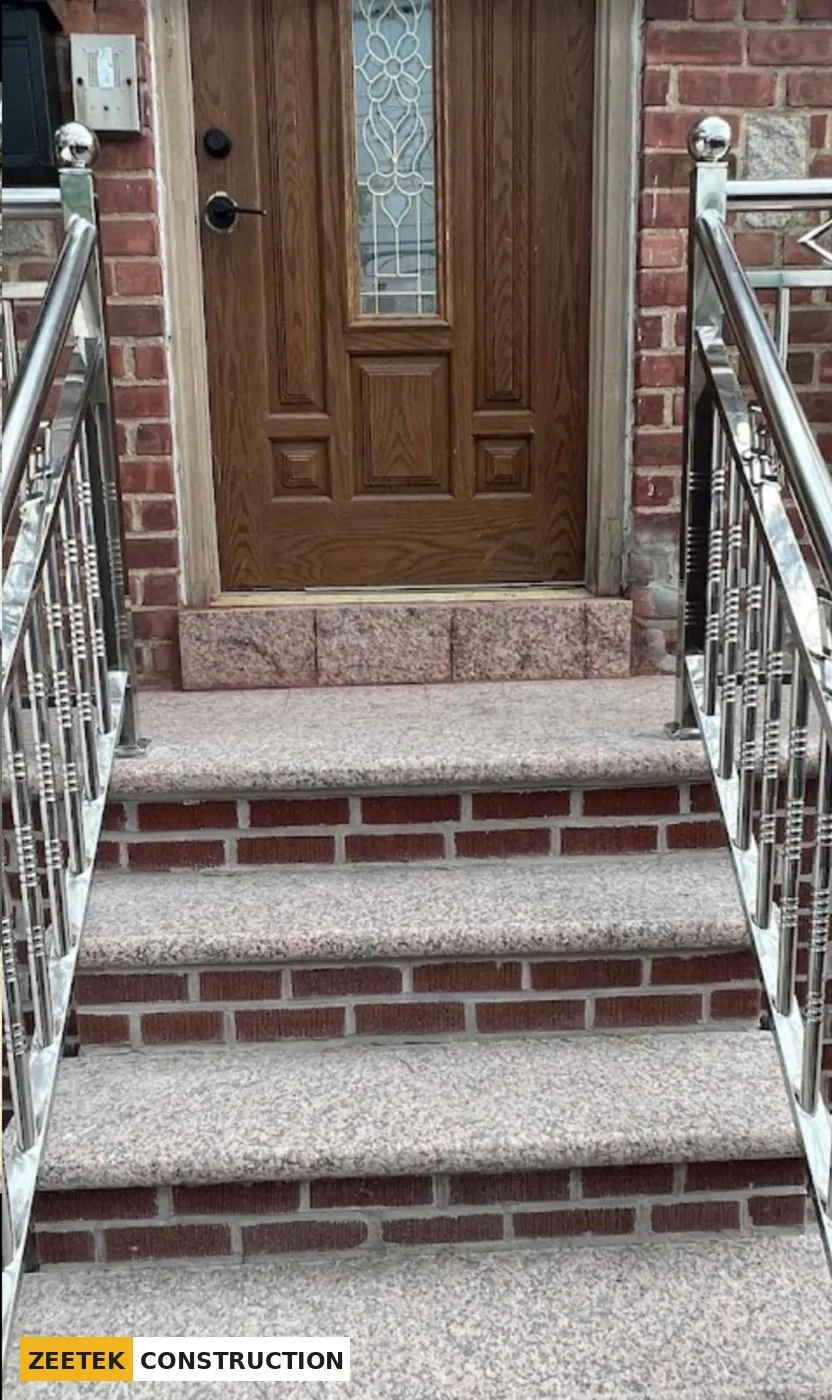
- Rebuild the stone elements that take the weather. Sills, lintels, copings, steps and treads are the pieces that fail first, because they are horizontal and hold water. Wall caps and copings have their own page.
- Clean, carefully, and only where cleaning is the point. Soiling that is doing no harm is often better left. Where cleaning is worth doing, it starts at the gentlest setting and stops as soon as it is working.
Cleaning stone: the pressure question, answered properly
Almost everybody guesses too high. The National Park Service’s guidance on cleaning masonry gives a figure, and it is far lower than the machines on sale suggest: “Starting with a very low pressure (100 psi or below), even using a garden hose, and progressing as needed to slightly higher pressure — generally no higher than 300-400 psi — is always the recommended way to begin.”
On stone the failure is quick and visible: too much water pressure etches a soft face in seconds and leaves the same roughened surface that blasting does. A wire brush is worse, and on limestone it leaves rust staining that outlasts everyone involved. We clean stone at the bottom of that pressure range with bristle brushes, or we leave it alone. The nozzle, distance and brush detail is on the power washing page.
Test first, in a corner, before anyone cleans a whole front
The NPS is unambiguous that testing is not optional: “testing the cleaner on an inconspicuous spot on the building is always necessary”, and tests “should be carried out in an area of sufficient size to give a true indication of their effectiveness”, preferably “in an inconspicuous location”.
There is a second reason to test that owners rarely anticipate: the test can change the decision, not just the method. The NPS illustrates it with a case where a small test area “revealed a red brick patch that does not match the original beige brick”, which “may explain why the building was painted, and may suggest to the owner that it may be preferable to keep it painted”. Strip a painted front without testing and you can uncover a century of patch repairs that were never meant to be seen.
Where we stop
We are masons. We are not architectural conservators, we hold no conservation accreditation, and we do not present ourselves as either. On a building of real significance, or where a stone element is carved rather than plain, a conservator should look at it before a contractor does.
If your building is in a landmarked district or is an individual landmark, work to the exterior generally needs Landmarks Preservation Commission approval before it starts, and that is the owner’s filing with their architect rather than something we do on your behalf. It is worth settling before anyone prices the stone, because what is approved decides the scope.
And where the stone is moving rather than weathering — a bulging course, a cracked lintel over an opening, a step that has dropped — that is structure rather than surface. A cracked or lifting head over a window is usually the lintel behind it rather than the stone itself.
What it costs
Every estimate is an itemised written scope of work, with exclusions stated. On stone the number moves on how many units actually have to come out, whether a matching stone can be sourced or has to be cut, how much of the joint work goes with it, the height and how the face is reached, and whether any approval has to be in place first. We would rather price the stones that genuinely need replacing than quote a whole elevation because it is easier to measure.
Our workmanship warranty: Two-year written warranty on our workmanship, from the day the job is signed off.
Already have a written quote? Send it over. We will go through it with you line by line, tell you what it covers and what it leaves out, and give you ours against the same scope.
The Bronx, Queens, Brooklyn, Manhattan and Staten IslandSend close-ups and one from across the street
Two kinds of photograph tell us different things. A close-up shows whether the face is spalling, delaminating or just dirty. One from across the street shows whether the problem is one stone or a pattern down the whole elevation, which is usually where the real answer is. The masonry page covers the rest of what a wall can need.